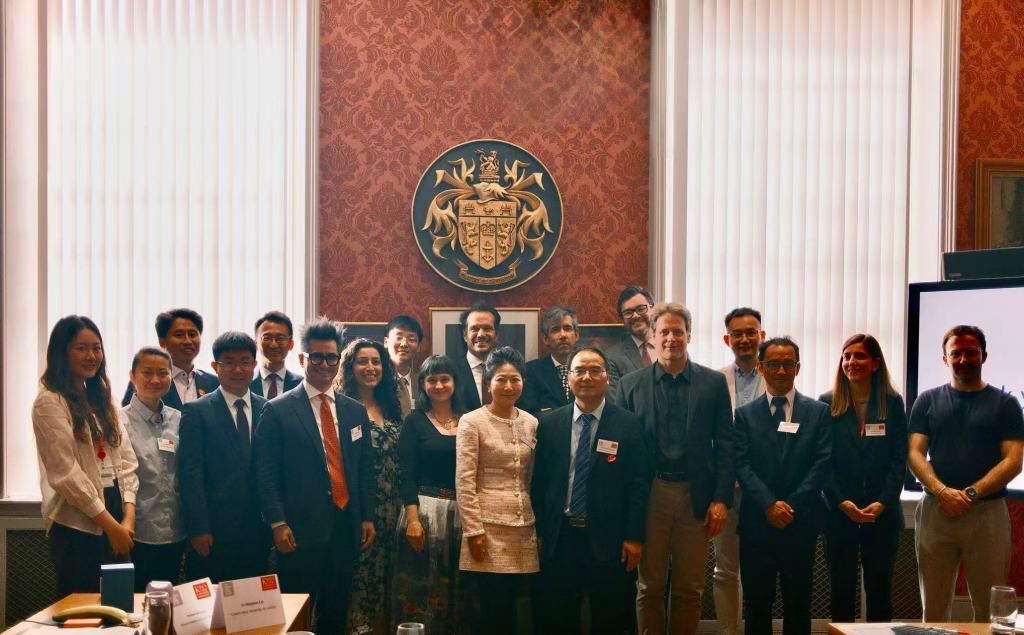
The 1st UK–China Artificial Intelligence Law Dialogue 2026 was successfully held at King’s College London on 15 June 2026. The event brought together distinguished legal scholars from London, Beijing and the wider international academic community for a high-level academic exchange on the legal and regulatory challenges raised by artificial intelligence, data governance and the future digital economy.
Hosted by The Dickson Poon School of Law and the Centre for Data Futures, with support from King’s Global Engagement Partnership Fund, the dialogue took place on King’s historic Strand Campus. It welcomed a senior delegation from the Institute of Law, Chinese Academy of Social Sciences (CASS), one of China’s leading legal research institutions and national think tanks.
The event opened with remarks from Professor Christoph Kletzer, Vice Dean International & Executive Education at The Dickson Poon School of Law, Professor Kerry Brown, Director of the Lau China Institute, and Professor Li Honglei, Chairman of the Board of the Institute of Law, Chinese Academy of Social Sciences.
Across the day, speakers examined some of the most important legal questions of our time: how artificial intelligence should be governed, how data should be protected across borders, and how law should respond to the digital transformation of markets, institutions and public life.
The first session, AI Governance and Emerging Regulatory Trends, considered public attitudes towards science and technology, AI agents and competition law, the credibility of AI-enabled information systems, AI for regulatory supervision and corporate compliance, and the UK’s approach to AI regulation in finance.
The second session, Data Protection and Cross-Border Data Governance, explored personal data protection, cross-border data compliance, comparative data governance in AI investment and robo-advisory services, the geopolitics of data protection, and the legal challenges posed by AI hallucination and data accuracy.
The third session, Legal Infrastructure for the Future Digital Economy: IP, Tax, and Fintech, addressed copyright challenges in AI training, central bank digital currency and regional payment connectivity, tax and automation, investment-based crowdfunding, and smart contracts as algorithmic governance mechanisms.
The dialogue was co-organised by Dr Lerong Lu, Reader in Law and Director of Postgraduate Studies at The Dickson Poon School of Law, together with colleagues from King’s and partner institutions. The event reflected King’s continuing commitment to international academic exchange and to advancing legal scholarship on AI, data, technology regulation and global governance.
Reflecting on the event, Dr Lerong Lu said:
“It was a memorable day of serious, open and thoughtful academic exchange on King’s historic Strand Campus. The discussions showed the importance of sustained comparative legal dialogue on AI and data. Despite differences in legal traditions and regulatory approaches, there is much to gain from scholarly exchange on accountability, innovation, public trust and the future legal infrastructure of the digital economy.”
The organisers are grateful to all speakers, chairs, participants and colleagues who contributed to the success of the event, with special thanks to The Dickson Poon School of Law, the Centre for Data Futures, the Lau China Institute, the King’s Institute for Artificial Intelligence, and colleagues across King’s College London for their support.
The dialogue marked an important step in strengthening academic engagement between King’s College London and the Institute of Law, Chinese Academy of Social Sciences. It is hoped that the conversations started at the event will continue through future academic collaboration, joint research and publication activities in the fields of AI law, data governance and comparative digital law.
